Guide
Ground mounted solar panels: when a yard array beats the roof
Ground mounted solar panels make sense when the roof is shaded, old or faces the wrong way. What a ground mount adds: footings, a trench, setbacks and permits.
Updated November 7, 20268 min readReviewed by SolarRealCost Editorial Team, editorial review: primary sources checked and independently fact-checked
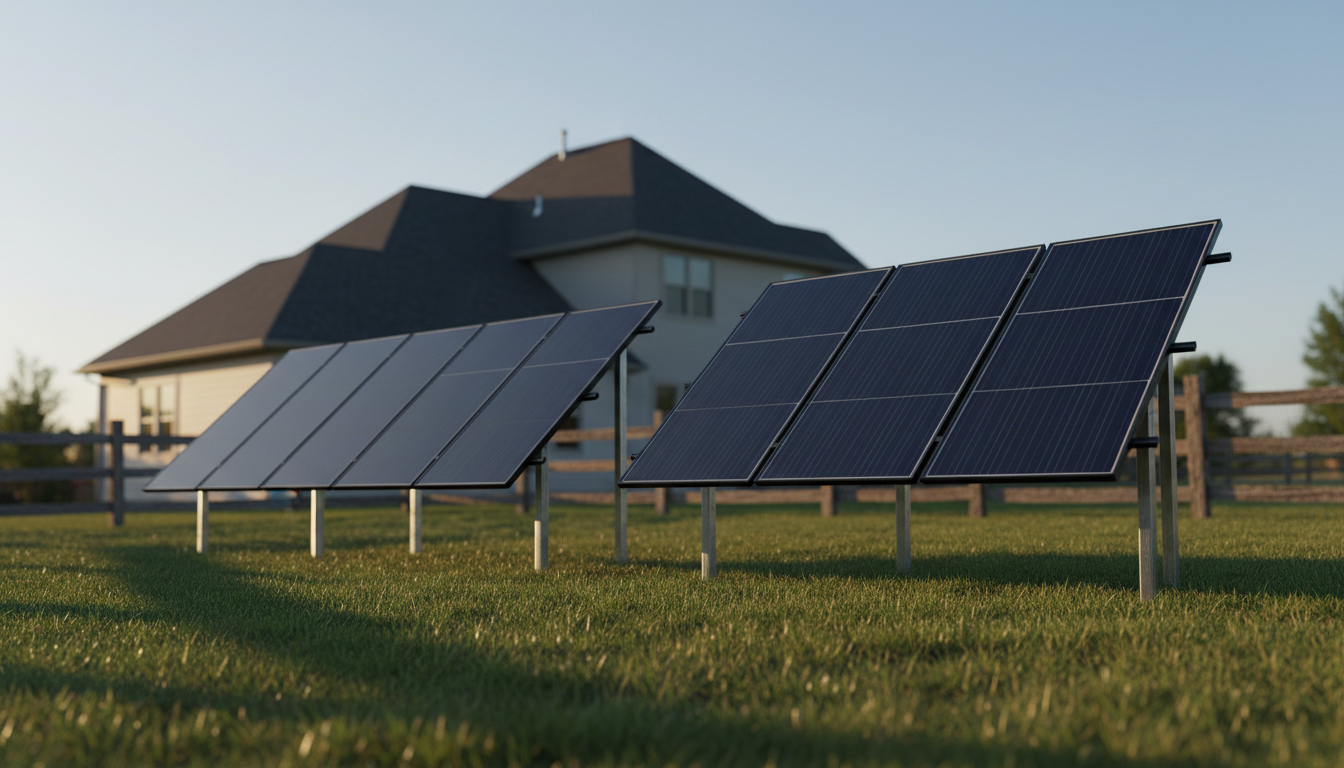
Ground mounted solar panels sit on a steel or aluminum frame anchored in your yard instead of on the roof. They tend to make sense when the roof is a poor host (shaded by trees, close to needing replacement, facing north, or too small) and you have open, sunny ground where the array can face south at a good tilt. In exchange they bring work a roof job doesn't: footings, a trench to carry the wiring back to the house, zoning setbacks and, in many places, a fuller permit review. If your roof faces roughly south, gets sun and has years left in it, a roof mount is usually the simpler job.
When ground mounted solar panels beat the roof
The Department of Energy's homeowner's guide to going solar names the usual problems: "rooftops may not be suitable for solar systems due to age or tree cover." A ground array gets around each of them, as long as the yard doesn't share the problem.
Shade on the roof. The same guide says that if trees near your home "create excessive shade on your roof, rooftop panels may not be the most ideal option." A sunny patch of yard away from those trees can be a better spot.
An old roof. The DOE also says to "consider the age of your roof and how long until it will need replacement." Panels on a roof that needs replacing in a few years have to come off and go back on, a cost our guide to solar roof replacement walks through. A ground array never touches the roof.
The wrong direction or pitch. The DOE says panels "perform best on south-facing roofs with a slope between 15 and 40 degrees, though other roofs may be suitable too." A north-facing house, or one whose only open roof faces east or west, loses output on every panel. On the ground, the installer picks the direction and the angle. The DOE's design basics say that "to obtain the highest annual energy output, modules in the northern hemisphere are pointed due south and inclined at an angle equal to the local latitude." Our guide to the best angle for solar panels covers tilt and direction in detail.
Not enough roof. Dormers, vents and a small footprint can leave too little room for the array your usage needs. Our page on solar panel size shows how much area a typical home system covers. A yard usually has more room, subject to the setbacks below.
Cooler panels. PVWatts, the national lab's production calculator, models the two mounts differently. Its array type help says the open rack option "is appropriate for ground-mounted systems" and "assumes that air flows freely around the array, helping to cool the modules." It assumes an operating temperature of 45 °C for open rack and 50 °C for roof mount, because "the array's output increases as the cell temperature decreases." The example below shows how much direction alone can matter.
How much direction costs a roof: one worked example
Most of a ground mount's edge comes from being able to face south when the roof can't. Our PVWatts calculator guide works through a live example: the same 7 kW Denver system modeled about 21% less facing west and about 17% less facing east than facing south. That gap is roughly what a ground array could win back on direction alone for a house like that, before its slightly cooler panels and before subtracting any shade between rows. For the open-rack type, PVWatts assumes "modules are arranged in rows" and estimates the shade one row casts on the next from the ground coverage ratio, which the PVWatts V8 API sets at 0.4 by default. Rows spaced farther apart lose less, and take more yard.
These are model results for one city, not a forecast for your house. To compare the two options for your own site, run PVWatts twice: once with "fixed (roof mount)" at your roof's real pitch and direction, and once with "fixed (open rack)" facing south at the tilt a ground array would use.
What a ground mount adds to the job
A roof mount uses the house as its structure and runs its wiring through the attic. A ground mount has to supply both. The local codes quoted below are examples from individual towns and counties, not national rules; your city or county sets its own.
Footings and engineering. The frame needs a foundation that holds up against wind and frost. Eureka Township, Minnesota's permit instructions (posted May 2022) require an engineer to certify "that the foundation and design of the solar panel(s) are within accepted professional standards, given local soil and climate conditions." Modoc County, California's ground-mount checklist (Policy M-007, enacted 2024-11-13) asks for a "foundation plan with footings" and requires a California-licensed engineer's approval "for PV arrays over 7' in height."
A trench back to the house. The wiring from the array to the inverter and the electrical panel usually runs underground. In Murrieta, California, the city's inspection checklist (May 2024) lists three inspections for a ground-mounted system: a footing inspection, an "underground electrical (raceway and conduits)" inspection, and a final. The longer the run from the array to the house, the longer the trench.
Setbacks, yard and height limits. Many towns treat a ground array as an accessory structure, like a shed. Eureka Township allows ground systems of 40 kW or less as accessory uses in all districts, but says they "shall not be placed in front yards," must meet accessory setback rules, may not exceed 15 feet in height, and count toward the township's limit on total accessory-structure square footage. They also have to meet its stormwater ordinance. New Carlisle, Ohio, is stricter: its solar permit form (updated November 2025) says ground systems in residential areas need a conditional use permit and Planning Board approval, and if approved belong in the rear yard only, at no more than 15 feet. It also counts them toward lot coverage.
A fuller permit review. Some cities can issue a rooftop solar permit almost instantly through SolarAPP+, an automated permitting tool. That route may not cover a ground mount: Roseville, California's SolarAPP+ page says the system "must be installed on a permitted main dwelling rooftop only (no trenching allowed)." Modoc County's ground-mount submittal asks for a site plan, an electrical plan and a single-line diagram.
More racking, and a decision about tilt. On a roof the panels follow the pitch. On the ground, someone has to choose. PVWatts' tilt help notes that higher tilt angles "tend to cost more for racking and mounting hardware, and may increase the risk of wind damage to the array." Trackers that follow the sun are another option for ground arrays. The DOE says tracking "provides more energy," but also "involves more up-front costs" and "more maintenance."
What a ground mount costs compared with a roof
We haven't found a government source that publishes a typical price difference for a home ground mount, and we won't repeat the figures on installer and cost sites. What we can say is where the extra money goes: the foundation, the trench and conduit, the added steel or aluminum, any engineering stamp, and the extra permit and inspection steps above. A higher price per watt can still be the better buy if the array produces enough more than a shaded or north-facing roof would.
Whichever mount you pick, compare quotes on dollars per watt, as our guide to what solar costs to install explains. And leave out the federal residential credit (section 25D): the IRS says it "is not available for any property placed in service after December 31, 2025."
When a ground mount makes no sense
- The roof is already a good host. South-facing or close to it, inside the DOE's 15 to 40 degree band, with little shade and years of life left. The ground mount's extra work buys little.
- The yard is shaded too. The same trees that shade the roof often shade the lawn. Without open sun, there's nothing to gain.
- Zoning leaves no spot. If the only open ground is the front yard, the codes above wouldn't allow it. Some lots also can't fit an array inside the setbacks.
- The run to the house is long. A distant sunny corner means a longer trench and longer wires. Get that priced before choosing the spot.
- You rent, or no spot works. The DOE points to community solar instead: it "allows multiple people to benefit from a single, shared solar array that can be installed on- or off-site."
Bottom line
Ground mounted solar panels are mostly a workaround for a poor roof. Over a good roof they rarely pay their way. They can face due south at the angle you choose and run a little cooler, which matters most when the roof is shaded, aging, small or facing the wrong way. They also need footings, a trench, zoning approval and more inspection, and no public source puts a reliable price on that extra. Model both options for your own site, ask your local building and zoning office what a ground array would need on your lot, and compare written quotes line by line.
Common questions
Are ground mounted solar panels better than roof panels?
Not by default. A ground mount can face due south at a chosen tilt and runs a little cooler than a roof mount, so it can produce more per panel. It also needs footings, a trench for the wiring and usually a fuller permit review, so it tends to win only when the roof is shaded, old, badly oriented or too small.
Do ground mounted solar panels produce more electricity?
Often somewhat more, mainly because they can be aimed south when the roof can't. In the worked PVWatts example in our guide to the PVWatts calculator, the same Denver roof system facing west modeled about 21% less than facing south, and PVWatts also assumes open-rack ground arrays run a little cooler than roof mounts.
Do you need a permit for a ground mounted solar system?
In the local codes we checked, yes. Ground mounts are usually treated as accessory structures with setback and height limits, and some places require more: New Carlisle, Ohio, requires a conditional use permit for a ground mount in a residential district. Check with your city or county building and zoning office.
How far does a ground mount have to be from the property line?
There is no national number. The local codes we read point to their own accessory-structure setbacks, keep ground arrays out of front yards, and cap height at 15 feet in the two examples that state one. Your zoning office has the figure for your lot.
How much more does a ground mount cost than a roof mount?
No government source we found publishes a typical premium for a home ground mount. The extra work is real (footings, trenching, more racking, engineering and inspections), so get it priced as separate lines in a written quote.
Sources
- U.S. Department of Energy: Homeowner's guide to going solar
- U.S. Department of Energy: Solar photovoltaic system design basics
- National Laboratory of the Rockies: PVWatts help, array type
- National Laboratory of the Rockies: PVWatts help, tilt
- National Laboratory of the Rockies: PVWatts system design help (System Advisor Model)
- National Laboratory of the Rockies: PVWatts V8 API documentation
- Eureka Township, Minnesota: Accessory solar energy systems permit instructions (posted May 2022)
- City of New Carlisle, Ohio: Solar panel permit (updated November 2025)
- County of Modoc, California: Ground mount PV permit submittal requirements and inspection checklist (Policy M-007, 2024)
- City of Murrieta, California: Residential solar PV system inspection checklist (DS-125, May 2024)
- City of Roseville, California: SolarAPP+
- IRS: Residential Clean Energy Credit
By SolarRealCost Editorial Team. First published November 7, 2026. Advertiser disclosure
Keep reading