Guide
How much energy does a solar panel produce, city by city
How much energy does a solar panel produce? From national-lab PVWatts runs, a 400-watt panel makes about 435 kWh a year in Seattle and 702 in Phoenix.
Updated October 26, 20264 min readReviewed by SolarRealCost Editorial Team, editorial review: primary sources checked and independently fact-checked
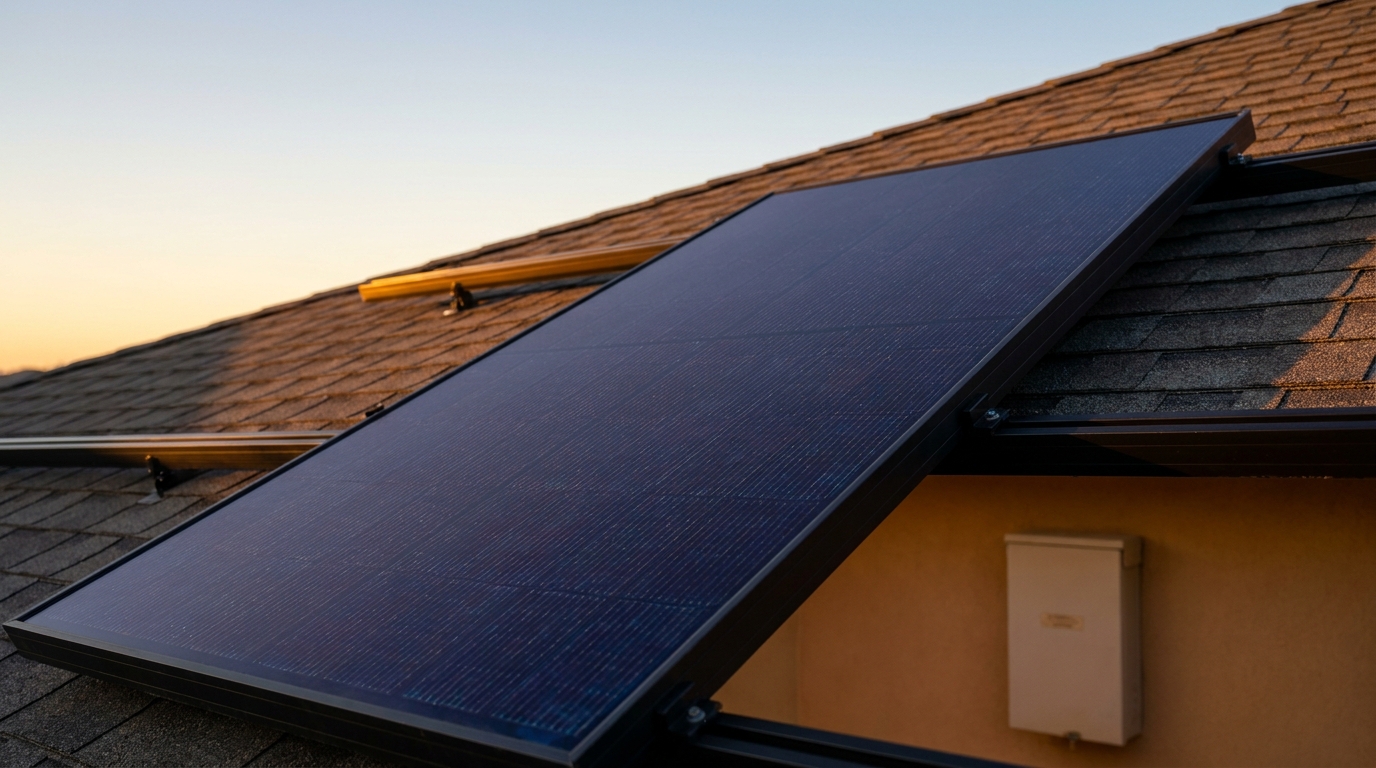
How much energy does a solar panel produce? A 400-watt panel on a south-facing roof makes roughly 435 kWh a year in Seattle and about 702 kWh in Phoenix, according to our runs of the national lab's PVWatts model. That's 1.2 to 1.9 kWh a day on average. The watt rating on the label tells you the panel's size, not what it makes, and location changes the answer by more than half.
Watts vs. kilowatt-hours: what the label tells you
The U.S. Energy Information Administration's guide to measuring electricity says "Watts measure power at a specific moment," while watthours measure electricity used over a period of time. "One kWh is one kilowatt generated for one hour." Your utility bill is in kWh, so that's the number that matters.
The watt rating on a solar panel comes from a lab test. The Department of Energy's performance basics explain that panels are tested under "a constant, standard level of light" while keeping a constant cell temperature. A roof gets nothing close to that. The sun sets, sits low in winter and goes behind clouds. Heat matters too: higher temperatures cause a small increase in current "but a much larger decrease in voltage," the DOE says, and the panel makes less power.
So a 400-watt panel is a 400-watt panel only in the test. To learn how much energy a solar panel will produce on your roof, you need a model that knows your weather.
How much energy does a solar panel produce where you live?
The National Laboratory of the Rockies (NLR, formerly NREL) runs PVWatts, a public online calculator that estimates a system's output for a given address. Version 8 uses 2020 typical-year weather data from the lab's National Solar Radiation Database.
We ran PVWatts V8 on 2026-10-14 for three cities with the same inputs: a 1 kW system, standard modules, fixed roof mount, 20° tilt, facing due south, 14% system losses. We then scaled the results to a single 400-watt panel (0.4 kW) by multiplying by 0.4. Your panel's rating is on its datasheet; scale the same way for a different size.
| City | Per kW, a year | 400 W panel, a year | 400 W panel, a day (average) | 400 W panel, July | 400 W panel, December |
|---|---|---|---|---|---|
| Seattle, WA | 1,088 kWh | 435 kWh | 1.19 kWh | 57 kWh | 13 kWh |
| Pittsburgh, PA | 1,191 kWh | 476 kWh | 1.30 kWh | 54 kWh | 22 kWh |
| Phoenix, AZ | 1,755 kWh | 702 kWh | 1.92 kWh | 63 kWh | 47 kWh |
The daily figures are yearly averages, and no single day looks like them. In Seattle, a July day produces several times what a December day does.
Another way to read the table: a 1 kW panel running at full rating every hour of the year would make 8,760 kWh. The Phoenix result is about 20% of that, and Seattle's about 12%. That gap between rating and output is normal. It's also why a sales pitch built on the watt figure alone can mislead you.
These are model estimates for one roof setup. Actual production varies with weather, soiling, shading and equipment. The DOE's homeowner guide says panels typically perform best on south-facing roofs with a slope between 15 and 40 degrees, so an east- or west-facing or shaded roof will usually come in below these numbers. PVWatts takes your address, tilt, direction and losses, so run it for your own roof.
How one panel compares with a home's use
The EIA's household electricity figures put the 2022 average at 10,791 kWh a year per U.S. residential customer, about 899 kWh a month. Louisiana customers bought the most, 14,774 kWh, and Hawaii customers the least, 6,178.
Against that average, one 400-watt panel in our runs covers about 4% of a year's use in Seattle, 4.4% in Pittsburgh and 6.5% in Phoenix. That's why home systems use many panels, and why the count changes so much by city. Turning your own bills into a system size is a separate step, covered in how many solar panels you need.
Bottom line
How much energy does a solar panel produce? Less than its label suggests, and it depends on where you live. In our PVWatts runs, a 400-watt panel made about 435 kWh a year in Seattle, 476 in Pittsburgh and 702 in Phoenix. Get yearly kWh for your own roof, check it against any quote, and only then look at what solar costs to install and whether solar panels are worth it at your electricity price.
Common questions
How much energy does a 400-watt solar panel produce in a day?
It depends on where it is. In our PVWatts runs for a south-facing roof at a 20° tilt, a 400-watt panel averaged about 1.19 kWh a day over a year in Seattle, 1.30 in Pittsburgh and 1.92 in Phoenix.
Why doesn't a 400-watt panel make 400 watts all day?
The watt rating is measured in the lab under a constant, standard level of light and a constant cell temperature. On a roof, the sun is down at night, low in winter and sometimes behind clouds, and heat lowers a cell's voltage.
What is the difference between watts and kilowatt-hours?
Watts measure power at one moment. Kilowatt-hours measure energy over time: one kWh is one kilowatt generated for one hour, according to the U.S. Energy Information Administration.
How many solar panels would it take to cover an average home?
The EIA puts average 2022 use at 10,791 kWh per U.S. residential customer. In our runs, one 400-watt panel covered about 4% of that in Seattle and about 6.5% in Phoenix. Sizing a whole system is its own step; start from your own bills.
Sources
- U.S. Energy Information Administration: Measuring electricity
- U.S. Energy Information Administration: How much electricity does an American home use?
- National Laboratory of the Rockies: Our history (formerly NREL)
- National Laboratory of the Rockies: PVWatts calculator
- National Laboratory of the Rockies: PVWatts V8 API documentation
- U.S. Department of Energy: Solar photovoltaic performance and efficiency basics
- U.S. Department of Energy: Homeowner's guide to going solar
By SolarRealCost Editorial Team. First published October 26, 2026. Advertiser disclosure
Keep reading