Guide
Solar panels for home: what they are and if your house fits
Solar panels for home, explained: what a rooftop system is made of, why most go dark in a power cut, and the checks to run before any quote.
Updated October 6, 20266 min readReviewed by SolarRealCost Editorial Team, editorial review: primary sources checked and independently fact-checked
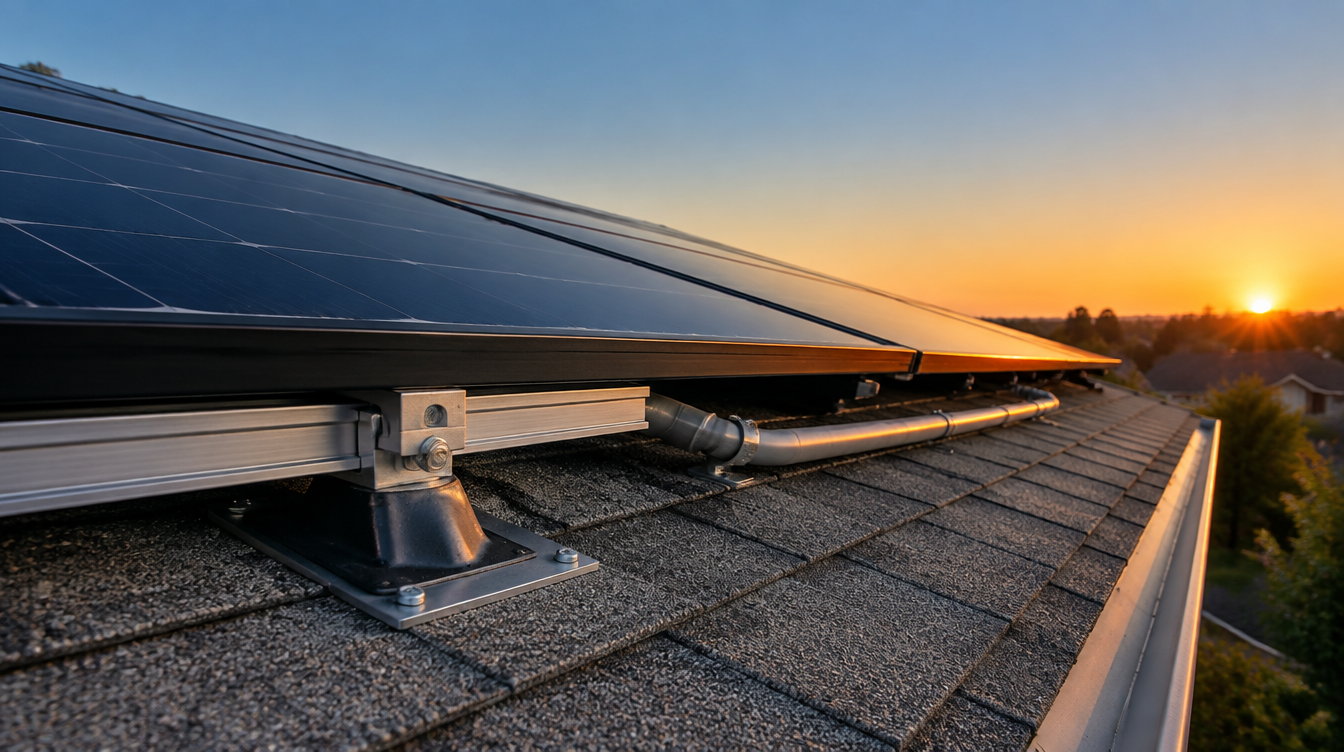
When people talk about solar panels for home use, they usually mean a grid-connected rooftop system: panels on racking, an inverter, and an agreement with your utility for the power you export. Whether one makes sense for your house comes down to your roof, your shade, your electricity use and your rate, and you can check all four before anyone gives you a quote.
What solar panels for home are actually made of
Panels. Each panel holds photovoltaic cells. According to the Department of Energy, sunlight absorbed by the cells sets up an electric field across their layers, and that makes electricity flow. What comes out is direct current (DC).
Racking. The rails and roof attachments that hold the panels. The DOE's PV design basics calls rack mounting the most common method because it is "robust, versatile, and easy to construct and install." The DOE notes an array "must be mounted on a stable, durable structure," and on most homes that structure is the roof, which is one reason the roof underneath matters so much.
The inverter. Your house and the grid run on alternating current (AC). The inverter converts the panels' DC into AC. The two setups the DOE describes for homes:
- a string inverter, where several panels feed one box. It costs less, but shade on one panel cuts the output of the whole string;
- microinverters, one per panel, so a shaded panel only drags down itself. They can cost more.
The utility connection. A grid-tied system stays connected to the grid. You use solar power when the panels produce it, draw from the grid when they don't, and send any surplus back. Your state and utility decide what you're paid for that surplus, the DOE notes. The installer doesn't.
A battery, if you want one. The DOE homeowner guide says storage lets you use daytime power later, including "when the power goes out." It's a separate purchase with its own economics, so price it as its own line.
Why most systems go dark in a power cut
A lot of buyers find this out the hard way. Under the standard for household inverters, the DOE explains, they ride through small voltage or frequency disruptions, but if a disruption "lasts for a long time or is larger than normal, they will disconnect themselves from the grid and shut down" (DOE inverter basics). So panels alone won't keep your lights on in an outage. The same page says solar-plus-battery systems can run without the grid during outages only "if they are designed to do so." If backup power is the reason you want solar, you're really shopping for a battery, and the quote should say so plainly.
Is your house a fit for solar panels? Four checks before any quote
1. Which way the roof faces, and how steep it is. The DOE homeowner guide says panels "perform best on south-facing roofs with a slope between 15 and 40 degrees, though other roofs may be suitable too." For the highest annual output, the DOE's design basics says modules in the northern hemisphere point due south, tilted at an angle equal to the local latitude. East- and west-facing roofs still produce. They just produce less per panel, which you can measure rather than guess.
2. Shade. The same guide says that if nearby trees "create excessive shade on your roof, rooftop panels may not be the most ideal option." Shade also decides which inverter setup makes sense, as described above.
3. The roof's age. The DOE tells homeowners to consider "the age of your roof and how long until it will need replacement." The DOE's design basics refer to "the 25-year lifetime of a PV array" (more in how long solar panels last), so price the roof first if it's getting old.
4. Your usage, after the easy cuts. System size should come from twelve months of your own bills. The DOE guide points out that efficient appliances mean "you'll need less solar energy to power your home," so a smaller array covers the same need. For reference, the guide says NREL's analyses use an average system size of 7.15 kilowatts, within a range of 3 to 11 kilowatts. The arithmetic for your house is in how many solar panels you need.
Check the production yourself
You don't have to rely on a salesperson's production figure. PVWatts, run by the National Laboratory of the Rockies for the Department of Energy, estimates the energy production of grid-connected PV systems at your address, for your roof's direction, tilt and losses. Anyone can use it. Its own caveats note assumptions, uncertainties and year-to-year weather variation, so treat any production figure, ours included, as an estimate.
Production is half the question. The other half is what that power is worth at your electricity rate, what your utility pays for exports, and what the system costs. Our tool runs all of it with the federal line set to zero.
What changed for 2026
Older guides, including the federal credit section of the DOE's own homeowner guide, describe a federal credit worth a percentage of the system's cost. For a home system placed in service in 2026, that no longer applies: the IRS says the Residential Clean Energy Credit "is not available for any property placed in service after December 31, 2025" (IRS). Any quote or article that still subtracts it is out of date. More in what happened to the federal solar credit.
Buying, financing, or not putting panels on your roof at all
You can pay cash, take a loan, or sign a lease or power purchase agreement (PPA). In a lease or PPA, the DOE explains, a solar company owns the system on your roof and you buy back the electricity it makes. The same guide notes that a purchased system can generally be installed at a lower total cost than one installed with a loan, lease or PPA. The trade-offs, including dealer fees and escalators, are in cash, loan, lease or PPA explained. Talk any financing decision through with someone qualified who isn't selling you the system.
If the four checks rule your roof out, or you rent, community solar is worth a look. The DOE describes it as an option for people who can't put panels on their roofs "because they are renters, can't afford solar, or because their roofs or electrical systems aren't suited to solar."
Bottom line on solar panels for home
A home solar system is panels, racking, an inverter and a utility connection, and it shuts down in a power cut unless you add a battery designed to run without the grid. Check your roof's direction, shade and age and your own usage, run the production yourself, and set the federal credit to zero. If the house passes, compare prices per watt in what solar costs to install. If it doesn't, community solar is still an option.
Common questions
What does a home solar system include besides the panels?
Racking that fixes the panels to the roof, an inverter that turns the panels' direct current into the alternating current your house uses, and an arrangement with your utility for the power you send back. A battery is optional.
Will solar panels keep my power on during an outage?
Not on their own. A grid-connected household inverter is designed to disconnect from the grid and shut down when a disruption lasts or is larger than normal. Running through an outage takes battery storage set up to do it.
Is my roof good enough for solar?
The Department of Energy says panels perform best on south-facing roofs with a slope between 15 and 40 degrees, though other roofs may work. Heavy tree shade and a roof that will need replacing soon are the two common problems.
How big is a typical home system?
The Department of Energy's homeowner guide says NREL's analyses use an average system size of 7.15 kilowatts, with a range of 3 to 11 kilowatts. Your own size comes from your bills and your roof, not the average.
What if my house can't take panels?
Community solar lets you subscribe to, or in some cases own, a share of a solar project in your area instead of using your own roof. The Department of Energy describes it as an option for renters and for people whose roofs or electrical systems aren't suited to solar.
Sources
- U.S. Department of Energy: Homeowner's guide to going solar
- U.S. Department of Energy: Solar photovoltaic system design basics
- U.S. Department of Energy: Solar integration, inverters and grid services basics
- U.S. Department of Energy: Community solar basics
- National Laboratory of the Rockies: PVWatts Calculator
- IRS: Residential Clean Energy Credit
- Federal Trade Commission: Buyer's remorse, the FTC's Cooling-Off Rule may help
By SolarRealCost Editorial Team. First published October 6, 2026. Advertiser disclosure
Keep reading