Guide
Solar inverter: what it does, the types, and the cost
A solar inverter turns your panels' DC power into AC for the house. The main types, why it shuts off in an outage, and why to budget for replacing it.
Updated October 26, 20266 min readReviewed by SolarRealCost Editorial Team, editorial review: primary sources checked and independently fact-checked
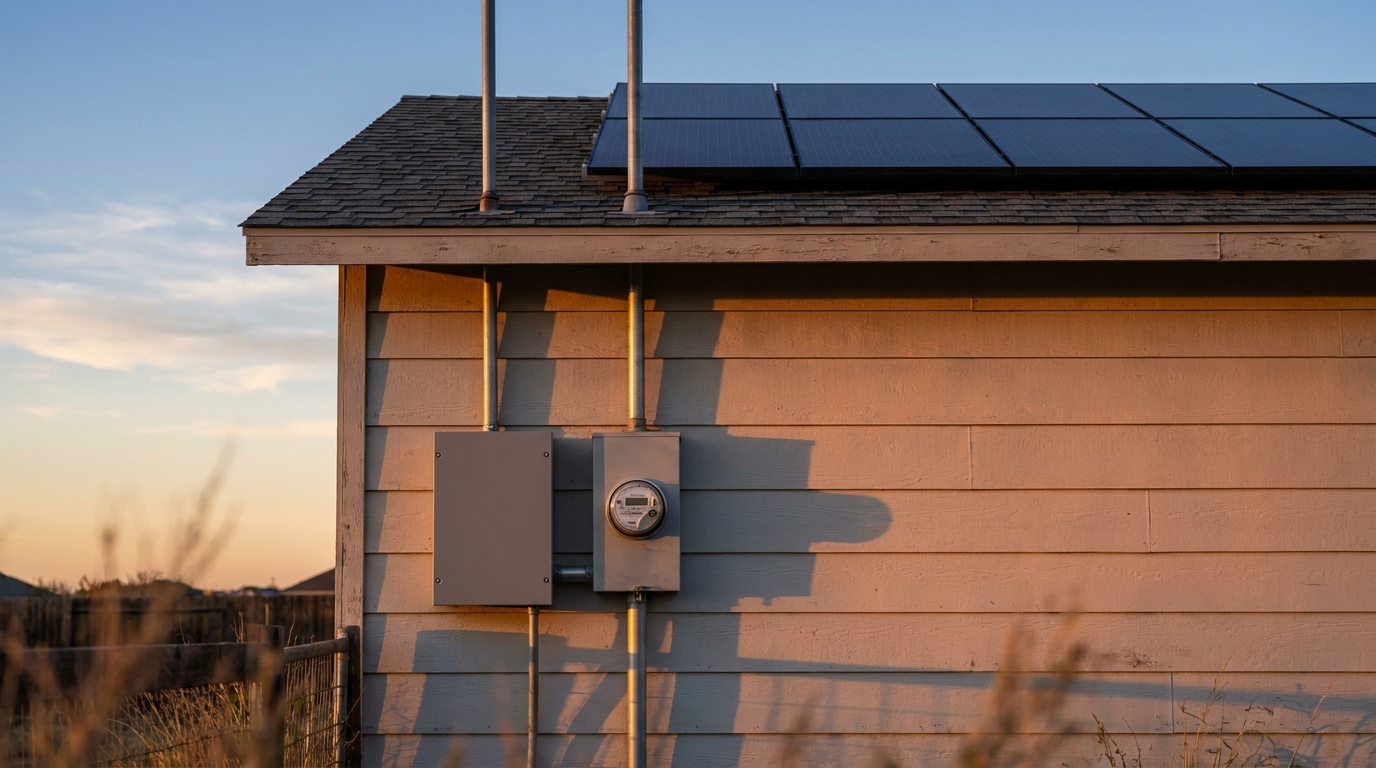
A solar inverter is the box that converts the direct current (DC) your panels produce into the alternating current (AC) your house and the grid run on. It's also a part you should expect to replace: the Department of Energy expects inverters to need replacing at least once over a 25-year array life. And most grid-tied inverters shut themselves off in a power cut.
What a solar inverter does
Solar panels make DC electricity. Your appliances, your wiring and the utility grid use AC. The inverter sits between them and, as the DOE's inverter basics put it, does the DC-to-AC conversion "by switching the direction of a DC input" back and forth. The same page calls it "one of the most important pieces of equipment in a solar energy system."
The conversion loses a little energy. The national lab's PVWatts production model uses a default inverter efficiency of 96% at rated power and accepts values from 90% to 99.5%. Advanced inverters, also called "smart inverters," can communicate both ways with the utility, according to the DOE's design basics.
It's normal for the inverter to be rated below the panels' total capacity. The ratio of panel capacity to inverter capacity is called the inverter loading ratio, or DC-to-AC ratio, and the National Laboratory of the Rockies' Annual Technology Baseline describes it as "a design choice." The national lab's cost benchmark models a typical home system as 8 kilowatts (kW) of panels with a ratio of 1.21, which works out to about 6.6 kW of inverter capacity (our arithmetic). Berkeley Lab reports that these ratios have generally grown over time as panel costs fell.
Types of solar inverter for a home
You'll see three setups on residential quotes, plus a fourth when a battery is involved.
| Setup | How it works | What the sources say |
|---|---|---|
| String inverter | A set of panels (a "string") feeds one inverter | Cost-effective, but output drops across the string if one panel has a problem such as shade |
| Microinverters | A small inverter on every panel | Shade or damage on one panel doesn't affect the others, but they can cost more |
| String inverter with DC optimizers | Electronics at each panel, feeding a string inverter | Also common in home systems, the national lab notes |
| Battery with an integrated inverter | The inverter is built into the battery unit | Can run without the grid if designed to; at least one common model doesn't work with panel-level electronics |
String inverters. The DOE says a string inverter "converts the power produced by the entire string to AC." The setup is cost-effective, but it "results in reduced power production on the string if any individual panel" has issues such as shading. The DOE's design page adds that a single inverter "is generally less expensive and can be more easily cooled and serviced when needed."
Microinverters. These are "smaller inverters placed on every panel." With one, "shading or damage to one panel will not affect the power that can be drawn from the others," but "microinverters can be more expensive," the DOE says. If parts of your roof are shaded for part of the day, this is the trade-off to ask about.
DC optimizers. Berkeley Lab groups microinverters and DC optimizers together as module-level power electronics, meaning equipment at each panel. The national lab's benchmark notes that it models microinverters, "although string inverters with direct current (dc) optimizers are also common."
Battery-based systems. The DOE says solar-plus-battery systems "rely on advanced inverters to operate without any support from the grid," and solar can charge the battery "directly over DC or after a conversion to AC." In Berkeley Lab's 2026 data update, the share of home systems using panel-level electronics fell substantially in 2025. Berkeley Lab ties the drop to rising battery attachment and to a popular home battery with an integrated inverter, which is incompatible with panel-level electronics, becoming more common. If you're adding a battery, the battery can decide the inverter setup, so ask how the two fit together. Our guide to solar battery cost covers what the battery itself adds.
Why a solar inverter shuts off in an outage
Household inverters are built to "ride through" small changes in grid voltage or frequency. If a disruption "lasts for a long time or is larger than normal, they will disconnect themselves from the grid and shut down," the DOE explains. So a standard grid-tied system goes dark in a blackout even on a sunny day. Keeping power on takes a system designed to run off-grid, which usually means a battery. We cover this in more detail in solar panels for home.
Solar inverter cost: what you'll see on a quote
There's no single list price for a home inverter, and figures vary with the type, the size and whether a battery is involved. What the national labs do show is where the inverter sits in the total. The National Laboratory of the Rockies' Annual Technology Baseline counts the inverter, rated in kW of AC, as part of a home system's capital cost. Berkeley Lab reports that soft costs (customer acquisition, installation labor, permitting, taxes and profit, among others) plus other balance-of-system costs made up "roughly 80% of the total installed price" of residential systems in 2025. The rest is Berkeley Lab's module and inverter price indices (lagged a year).
The inverter is a real line on the quote. Still, when two quotes are far apart, ask what else is in each price besides the equipment. Our estimator treats equipment prices as adjustable assumptions, so you can test a quote against your own numbers.
When you compare quotes, ask each installer to state:
- the inverter type (string, microinverters, string with optimizers, or battery-integrated);
- how many inverters, and their AC rating against the panels' DC rating;
- the inverter warranty term and what it covers, including labor;
- what a replacement would involve, especially for equipment on the roof.
Our checklist of what a solar quote must show lists the other lines worth asking for.
Plan for replacing the inverter
The DOE's design basics say "it is expected that inverters will need to be replaced at least once in the 25-year lifetime of a PV array," and the lab's Annual Technology Baseline models a home system over a 30-year lifetime. A savings estimate that leaves out an inverter replacement is too optimistic. Our guide to how long solar panels last covers the rest of the system's lifespan.
A replacement installed in 2026 doesn't get federal help either. The IRS says the Residential Clean Energy Credit (section 25D) "is not available for any property placed in service after December 31, 2025," and the credit is claimed for the year the property is installed, not merely purchased.
Bottom line
A solar inverter turns your panels' DC into the AC your house uses. A string inverter is generally cheaper and easier to service. Microinverters cope better with shade and can cost more, and a battery can decide the setup for you. Most inverters shut off in an outage unless the system is designed for backup, and you should expect to replace the inverter at least once. Get the type, rating and warranty in writing, then compare the whole price against what solar costs to install.
Common questions
What does a solar inverter do?
It converts the direct current (DC) electricity your panels make into alternating current (AC), which is what your home's appliances and the grid use. The Department of Energy calls it one of the most important pieces of equipment in a solar energy system.
What is the difference between a string inverter and microinverters?
A string inverter takes the power from a set of panels in one box, which is cost-effective, but a problem such as shade on one panel reduces the output of the whole string. Microinverters sit on every panel, so shade or damage on one panel doesn't affect the others, but they can be more expensive.
How often does a solar inverter need replacing?
The Department of Energy expects inverters to need replacing at least once in the 25-year lifetime of a solar array. Ask any installer what the inverter's warranty covers and for how long.
Will my solar inverter keep the power on in a blackout?
Usually not. Household inverters ride through small grid disruptions, but disconnect and shut down when a disruption is long or larger than normal. Running without the grid takes a system designed for it, typically with a battery.
Does a replacement inverter qualify for the federal residential credit?
Not if it's installed in 2026. The IRS says the Residential Clean Energy Credit (section 25D) is not available for any property placed in service after December 31, 2025, and that it was claimed for the year the property is installed, not merely purchased.
Sources
- U.S. Department of Energy: Solar integration, inverters and grid services basics
- U.S. Department of Energy: Solar photovoltaic system design basics
- Lawrence Berkeley National Laboratory: U.S. Distributed Solar and Storage, 2026 Data Update
- National Renewable Energy Laboratory: U.S. Solar Photovoltaic System and Energy Storage Cost Benchmarks, Q1 2023
- National Laboratory of the Rockies: Annual Technology Baseline 2025, residential PV
- National Laboratory of the Rockies Developer Network: PVWatts v8 API documentation
- IRS: Residential Clean Energy Credit
By SolarRealCost Editorial Team. First published October 26, 2026. Advertiser disclosure
Keep reading